









The market has been subjected to a rollercoaster of expectations regarding a negotiated settlement to the conflict in recent days. Following the optimism that prevailed on Tuesday and Wednesday, Friday brought a reality check as Washington and Tehran traded strikes in the Middle East, casting doubt on the viability of the truce.
Despite the flare-up in hostilities, U.S. President Donald Trump stated that the ceasefire -- which has been precariously maintained for a month -- remained in effect, leaving some hope for a diplomatic solution to the conflict.
The deteriorating geopolitical landscape pushed oil prices higher, with crude trading back around 100 dollars per barrel after three consecutive sessions of declines, adding pressure to the markets on the final day of the week.
On the corporate front, the flow of quarterly reports continued. Anglo-Spanish airline IAG warned that its annual profit will be lower than initially forecast due to rising aviation fuel costs and supply disruptions stemming from the war in Iran, factors that will weigh on its accounts more than the company had anticipated.
Technology, by contrast, partially mitigated geopolitical concerns. Demand for artificial intelligence boosted chipmakers and allowed several Asian markets to head toward significant weekly gains.
Investment in the sector has buoyed markets in recent months, and on Friday the Financial Times reported that Anthropic is considering a funding round to expand its computing capacity that would bring its valuation closer to one trillion dollars.
Investors were also awaiting the release of the U.S. monthly jobs report, for which economists polled by Reuters forecast an average of 62,000 jobs created in April, compared to the 178,000 recorded in March.
'(...) the tone is rather negative and is expected to persist for the remainder of the session. Profit-taking that we interpret as healthy and logical after the rally of recent sessions', said analysts at Bankinter.
'The market backdrop has improved substantially: (i) lower tension on the geostrategic front and (ii) frankly good corporate results (EPS in the U.S. stands at ca. +30% vs +14% expected), although it is healthy for the market to moderate its pace...', they added, according to comments taken from their morning note.
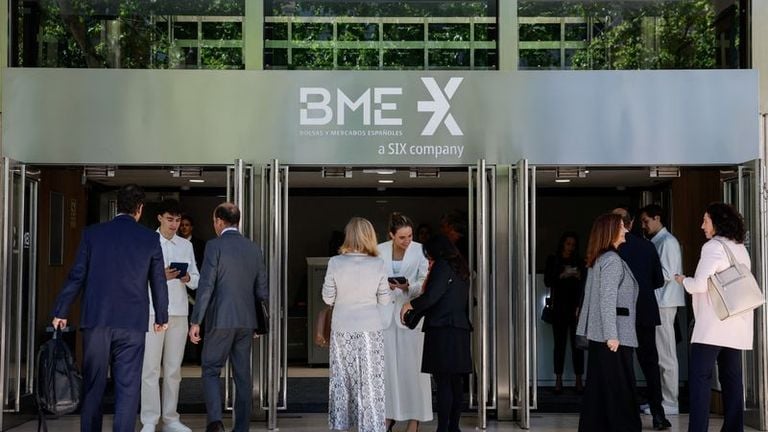
At 0705 GMT on Friday, the Spanish blue-chip IBEX 35 was down 128.10 points, or 0.71%, at 17,932.70 points, while the pan-European FTSE Eurofirst 300 index retreated 0.72%.
For the week as a whole, the IBEX 35 shows a gain of 0.85%.
In the banking sector, Santander lost 1.46%, BBVA fell 1.29%, Caixabank shed 0.82%, Sabadell dropped 0.68%, Bankinter slipped 0.92%, and Unicaja Banco lost 1.01%.
Among large-cap non-financial stocks, Telefonica retreated 0.75%, Inditex shed 0.95%, Iberdrola slipped 0.43%, Cellnex fell 0.71%, and oil major Repsol rose 0.46%.
(Reporting by Tomas Cobos; editing by Benjamin Mejias Valencia)


