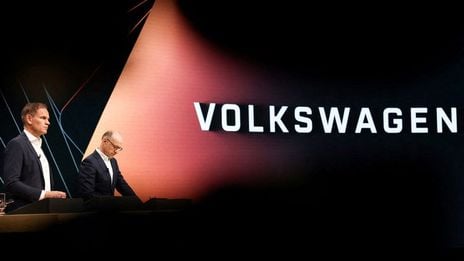
Volkswagen considers transforming plant towards military production
The German automaker is exploring a strategic pivot for its embattled Osnabrück site by entering talks with Israel's Rafael Advanced Defense Systems, the manufacturer of the Iron Dome missile defense system.
According to reports in the Financial Times, discussions are underway to transform the facility with the aim of producing components for air defense systems. This move comes as the European automotive industry undergoes a profound transformation, grappling with declining profitability, intensifying competition from Chinese manufacturers, and the challenges of electrification.
Industrial repositioning
The project seeks to safeguard 2,300 jobs at the Osnabrück plant, where vehicle production is slated to be phased out by 2027. This conversion would enable the manufacturing of logistical elements for the Iron Dome system, such as military trucks, launchers, and power generators, though it would not include missile production. The proposed timeline suggests production could begin within 12 to 18 months, contingent upon employee approval of the shift in operations.
Convergence of automotive and defense
This initiative reflects a broader trend in Europe: the alignment of automotive industrial capacity with the needs of a defense sector that has seen rapid growth since the onset of the war in Ukraine. In France, competitor Renault recently partnered with Turgis & Gaillard to develop a military drone division.
Germany plans to invest over €500bn in defense by 2030, with air defense systems identified as a top priority. In this context, Rafael intends to establish European production and market its systems to several governments. According to the Financial Times, the project has the backing of German authorities, who are encouraging the repurposing of excess industrial capacity.
A return to military production
Volkswagen is no stranger to the defense industry. The group already produces military trucks through a joint venture between its subsidiary MAN and Rheinmetall. However, a direct partnership with Rafael would mark a more symbolic turning point.
This repositioning remains to be confirmed. Volkswagen has stated it is in discussions with various partners, noting that no final decision has been reached regarding the future of the Osnabrück site.
Volkswagen AG is a Germany-based company, which manufactures and sells vehicles. The Group consists of two divisions: the Automotive Division and the Financial Services Division. The Automotive Division comprises the Passenger Cars, Commercial Vehicles and Power Engineering business areas. This division focuses on the development of vehicles, engines and vehicle software, the production and sale of passenger cars, light commercial vehicles, trucks, buses, and motorcycles, as well as businesses for genuine parts, large-bore diesel engines, turbomachinery, and propulsion components. The Financial Services Division focuses on dealer and customer financing, leasing, direct banking, and insurance activities, fleet management and mobility services. Its brand portfolio includes Volkswagen, Audi, SEAT, SKODA, Bentley, Lamborghini, Porsche, Ducati, Volkswagen Commercial Vehicles, Scania, and MAN.
This super rating is the result of a weighted average of the rankings based on the following ratings: Valuation (Composite), EPS Revisions (4 months), and Visibility (Composite). We recommend that you carefully review the associated descriptions.
Investor
Investor
This super composite rating is the result of a weighted average of the rankings based on the following ratings: Fundamentals (Composite), Valuation (Composite), EPS Revisions (1 year), and Visibility (Composite). We recommend that you carefully review the associated descriptions.
Global
Global
This composite rating is the result of an average of the rankings based on the following ratings: Fundamentals (Composite), Valuation (Composite), Financial Estimates Revisions (Composite), Consensus (Composite) and Visibility (Composite). The company must be covered by at least 4 of these 5 ratings for the calculation to be carried out. We recommend that you carefully review the associated descriptions.
Quality
Quality
This composite rating is the result of an average of rankings based on the following ratings: Returns (Composite), Profitability (Composite) and Quality of Financial Reporting (Composite), and Financial Health (Composite). The company must be covered by at least 2 of these 3 ratings for the calculation to be performed. We recommend that you carefully read the associated descriptions.
ESG MSCI
ESG MSCI
The MSCI ESG score assesses a company’s environmental, social, and governance practices relative to its industry peers. Companies are rated from CCC (laggard) to AAA (leader). This rating helps investors incorporate sustainability risks and opportunities into their investment decisions.